
 Having choices, broad capabilities and feature sets, is definitely a good thing. All of the previously discussed categories of Quick-MI (4 of the 5 categories)…
…represent the critical components that illuminate the key variables instrumental in the sustained success of many current and emerging products, increasingly becoming part of the Modular Innovation trend.
Having the Flexibility, and being pliable and easy to grasp, further enhances the relationships inherent in successful and emerging products. Flexibility, in the abstract, prevents important relationships from breaking. Without Flexibility, a relationship becomes rigid. Rigid, brittle relationships don’t respond well to strain…
control,
self-determination,
change,
etc.
…often failing under the pressures of the people and products involved.
Modular Innovation (MI) is all about relationships, be they between people or products online. In looking at how these relationships are established, maintained, enhanced, and expanded, one can achieve greater insight into the underlying forces shaping Modular Innovation, quantifying the degree by which a product is participating within, as well as evolving towards greater degrees of, Modular Innovation.
Equally important among the 5 categories that make up Quick-MI, is Flexibility. Flexibility is the measure of both the ease and degree of adaptability and customization permitted by a product.
In abiding with the overarching goals of both Quick-UX and Quick-MI (quick assessment for summary, directional guidance, and quantitative comparison), the variables constituting the minimal representative subset for Flexibility are…
- Customizability
- Standardization
Each variable and category (e.g. Flexibility) is assigned a value that can be compared and combined. When all the categories’ values are combined, they form the Modular Innovation Index of a product.
Customizability
Customizability is the measure of degree of plasticity of the other 4 categories of Quick-MI. The overall Customizability of the core components of Quick-MI as represented via a product’s present capabilities is sufficiently important to be represented by independent quantification.
Of each feature set representative of each individual Quick-MI category, Customizability is the evaluation of the proportion of the present capabilities that can be customized and adjusted to desired preferences. An example of Customizability of a data feed can be found in the permitting of the recipient, via an API, to customize the format of the data feed, e.g. choosing between JSON or XML.
The Customizability variable’s value is the sum of evaluated Customizability for each individual Quick-MI category; thereby, resulting in a maximum value of 4 (a maximum value of 1 per category: Sharability, Interoperability, Portability, and Convenience). Each Customizability value is determined to be…
- 0 if the Quick-MI category does not allow any Customizability,
- 0.5 if the capabilities associated with the Quick-MI category are allowed some Customizability and indication of preference, or
- 1 if the all capabilities associated with the Quick-MI category can be Customized and have preferences indicated.
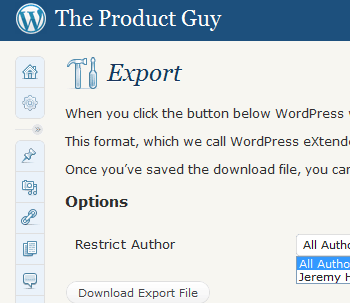 WordPress proves a good source for demonstrating the variable value for the Customizability of the Quick-MI category of Portability’s variable User Generated Content Exportability, with this product allowing for some customization of the exported content, by way of controlling which authors are included within the resultant output.
Standardization
The benefits and value associated with Quick-MI’s Flexibility category are weakened through the lack of adherence to common practices and standards. The more non-proprietary, standard methods and formats are employed, the more they will be used in the relationships between product-product and people-product. And, in turn, the more resilient will be these relationships.
Some good questions to ask when evaluating the extent of Standardization within a product are…
- Is there a non-standard API?
- Is the resultant file in a proprietary file format?
- Are standard methodologies employed throughout?
The Standardization variable is assigned the value of…
- 0 if no standard methods or non-proprietary formats are employed within the product,
- 0.5 if some places within the product make use of commonly accepted practices and formats, or
- 1 if all of the product’s touch points follow common standards, methodologies and formats.
 Identi.ca is a micro-blogging service much like Twitter. But, unlike Twitter it is built based on free and open software standards, implementing the OStatus suite of standardized protocols; resulting in a Standardization variable value of 1.
Fast and Flexible
Quick-MI is all about understanding and measuring the relationships formed and supported between online products, especially those pioneering the next generation of web products via Modular Innovation.
With too much rigidity, an inflexible relationship can strain and even break. Flexibility of the components of Quick-MI and simplification of benefiting from that Flexibility, through adherence to commonly accepted standards, is crucial to forming strong, sustainable products and product relationships.
Altogether, the 5 categories of Quick-MI …
Sharability,
Interoperability,
Portability,
Convenience, and
Flexibility,
… constitute a sound, representative, quantitative understanding of a product’s ability to foster and maintain relationships both within and without — yielding an oft missed, yet critical, perspective into the success and sustainability of an online product.
Enjoy, Discuss & Tweet!
Jeremy Horn
The Product Guy
PS Try it out, tweak it, learn more about Modular Innovation and share you experiences.
 The Product Guy