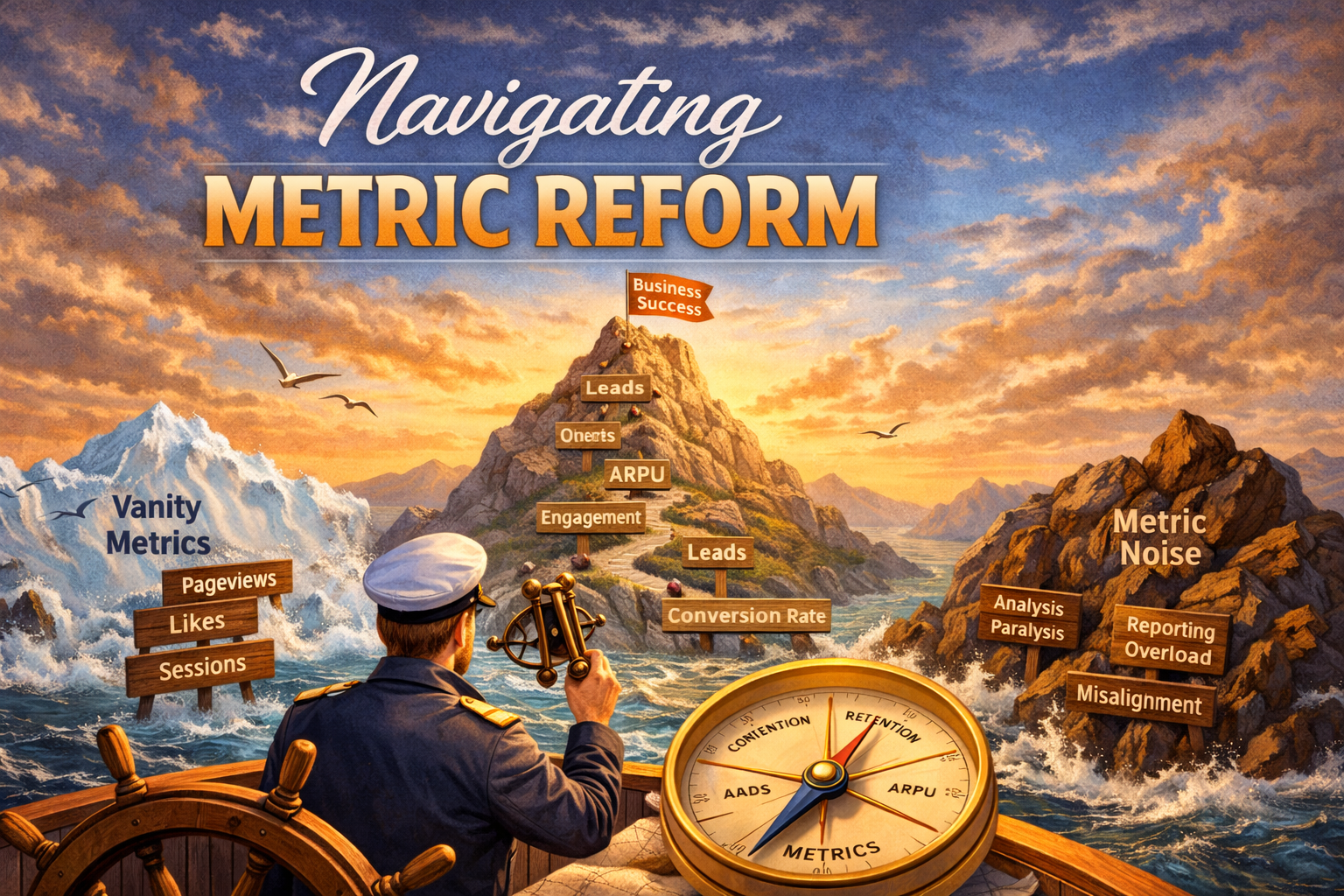

Your team tracked page views per session for two years. The number correlated with purchase intent, and every quarterly review referenced it. Then the product added a comparison feature and browsing behavior changed. Page views kept climbing while conversion stayed flat. The metric was still green on the dashboard. It just stopped telling the story everyone believed it was telling.
That moment, where a familiar number decouples from the outcome it was supposed to predict, is where most metric reform conversations begin. The latest Roadmap to Mastery article on The Product Way traces what happens next, and the three dynamics that determine whether the reform builds momentum or stalls.
The first is the activity-to-outcome transition, and it is harder than the principle suggests. Page views per session predicted purchase intent because browsing and buying were coupled in the original product design. That coupling was real, which is what made the metric feel trustworthy for two years. The complication is that product changes, market shifts, and changes in user population can break the coupling without breaking the metric. The number still moves. It just stops meaning what it used to. Teams that recognize the shift can recalibrate, and the recalibration requires judgment about which correlations still hold, which ones have weakened, and which leading indicators now predict the outcome more reliably. A metric like qualified lead velocity or repeat session depth may track conversion intent more accurately in the new product environment, and identifying that replacement before retiring the old metric gives leadership something meaningful to watch during the transition. The judgment call differs by product maturity: early-stage products where the original correlation was never rigorously validated need different leading indicators than mature products where a once-reliable correlation has started to decay.
The second dynamic is the political economy of measurement. Page views per session did not live on the dashboard alone. Marketing referenced it to demonstrate campaign effectiveness, product used it to justify feature investment, and the executive who presented it to the board built a quarterly growth narrative around it. Each of those stakeholders has a relationship with the metric that extends beyond its informational value, and proposing to retire it starts a conversation about visibility and contribution that goes well beyond data hygiene. The reform works when leaders can show each function that their contribution remains visible through the new measurement. Making that visibility explicit before proposing the change means the conversation becomes an evaluation of a trade where each team can see what they gain, and that framing is what moves the discussion forward.
The third is sequencing, and it determines whether political capital builds or exhausts across the reform effort. The first metric to retire should be the one with the weakest constituency, the number that appears in the fewest reports and that the fewest stakeholders would miss. Removing it generates the least resistance and produces the first evidence that the dashboard can function with fewer numbers. That evidence is the foundation for every subsequent conversation. The second round can target a more protected metric with credibility behind it, because the organization has already seen that removing a number did not create a blind spot. Each successful round expands the team’s ability to propose changes that would have been politically impossible at the start.
The thread connecting all three dynamics is that metric reform compounds. A successfully retired metric builds credibility for the next conversation. A transitional quarter where leadership tolerates a slow-moving outcome metric builds organizational patience for ambiguity. And the leading indicators that demonstrate a causal relationship to outcomes give the team a bridge between the old measurement system and the new one, which is what makes the patience sustainable over multiple quarters. The organizations that reach the other side of this process end up with dashboards where every number connects to a decision, and where the team’s time is spent interpreting signal that actually informs the work.
The March TPG Live roundtable surfaced these dynamics, and the Roadmap to Mastery article goes deeper into the organizational forces that determine whether each step succeeds: the specific conversations leaders need to have before proposing a change, how to identify which correlations have decayed, and what the transitional quarter looks like when it is managed well.
Watch the full March TPG Live roundtable replay: https://youtu.be/QXYf_HY8ZEo
For non-members: Join The Product Way to access the full article, the complete Roadmap to Mastery series, PM Select (curated introductions to trusted hiring managers), and weekly strategies: https://patreon.com/TheProductWay/membership
For existing members: Read the full article on Patreon: https://www.patreon.com/posts/patreon-why-your-155105157
#ProductManagement #ProductLeadership
 The Product Guy