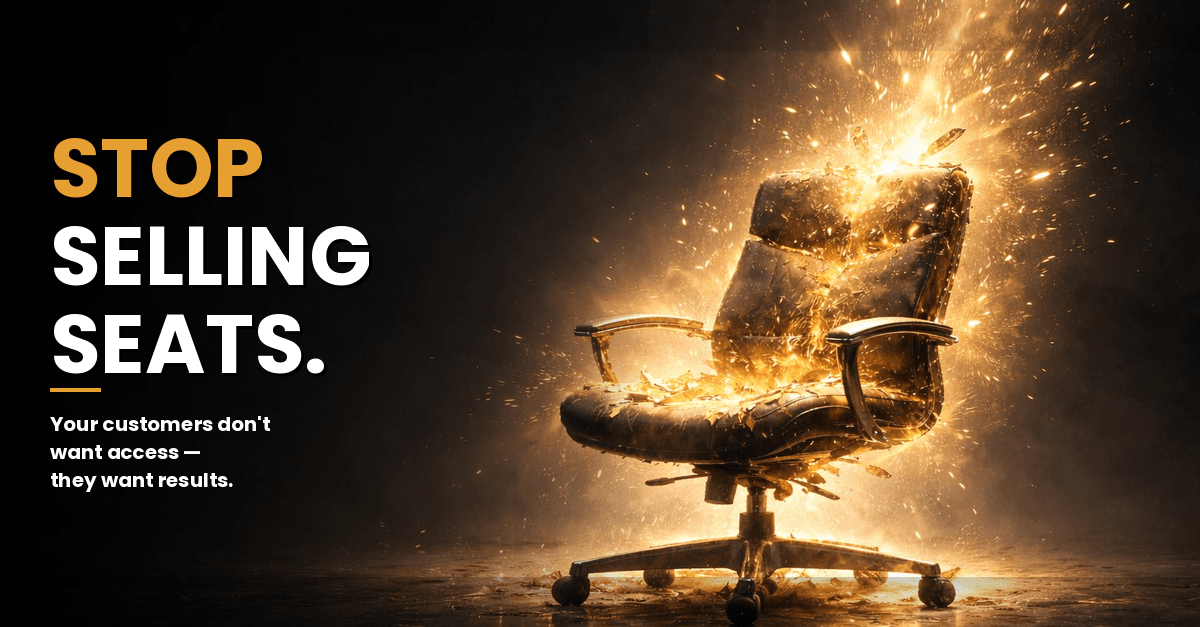

The per-seat pricing model is structurally broken. Not because buyers got cheap, but because the unit stopped matching reality.
AI agents don’t need logins. They don’t buy licenses. When an AI can manage pipeline, qualify leads, draft follow-ups, and forecast deals, the number of humans touching the software stops being a useful proxy for the value the software delivers. And yet, most of enterprise SaaS is still priced as if every dollar of value requires a human sitting in a chair.
This isn’t a prediction. It’s already happening. Intercom moved from per-seat to per-resolution. Sierra launched with outcome-based pricing from day one. Riskified has been pricing per successful transaction for years. The pattern is clear: define the outcome your product delivers, instrument it, and price against it.
I just published what I consider the most complete argument I’ve made on this topic — a long-form breakdown of outcome-based pricing as the structural replacement for per-seat SaaS and time-and-materials billing across software, consulting, and digital services.
What the Article Covers
The Salesforce case study. I walk through exactly how Salesforce, the poster child of per-seat pricing, would work on an outcome-based model. Qualified pipeline generated. Deals closed through the platform. Forecast accuracy delivered. The math shows why this isn’t just viable, but better for both sides.
Three modes of outcome-based pricing. Not every deal is the same. Sometimes the client defines the outcomes. Sometimes you co-design them together. Sometimes the provider defines the outcome unit and prices against it. Each mode maps to a different delivery model — enterprise consulting, digital services, and SaaS at scale.
The incentive inversion. Under per-seat pricing, AI efficiency cannibalizes revenue. Under outcome-based pricing, AI efficiency expands margins. Same technology investment, opposite financial result; all driven entirely by the pricing model. This is why the transition is inevitable.
The KPMG signal. Your clients already have the leverage. KPMG used the existence of AI to pressure their auditor into a 14% fee cut without automating a single thing. That playbook works in every SaaS renewal and every consulting engagement from here forward.
The operational framework. How to establish baselines, choose proxies over pure outcomes to avoid attribution fights, structure layered incentives that reward exceeding targets, and build the data flywheel that compounds your advantage over time.
Why I Wrote This
I’ve been working on outcome-based pricing for years … not as a theory, but as an operating model. At Cognizant, I led the strategy that shifted our digital business go-to-market from competing on who could build it cheapest to competing on who could deliver the business outcome the client actually needed. We stopped scoping deliverables and started scoping results. The margins followed.
The recent market events — $285 billion in SaaS market cap repriced in 48 hours over a structural pricing argument — confirmed what I’ve been saying: this transition is accelerating, and most companies aren’t ready.
The article is the playbook.
Read the Full Breakdown
The complete article, including the Salesforce case study, the three-mode framework, the operational mechanics, and the argument for why AI makes this model inevitable, is on LinkedIn:
→ Stop Selling Seats. Your Customers Don’t Want Access — They Want Results.
If this is the kind of clarity you need in your business, let’s talk.
Jeremy Horn (aka The Product Guy) is the founder of The Product Group and The Product Way.
 The Product Guy